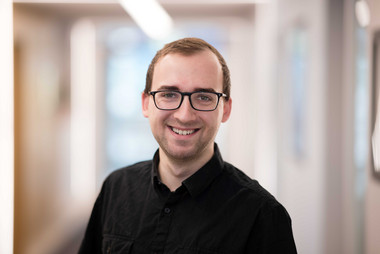
Many people primarily associate the term "streamer" with Twitch or YouTube streamers who take their viewers into their gaming world or share their music online as DJs. But these days, "streaming" is also a real profession. Editor Janina Singer talks to mbw streamer Maximilian Schmidt about what that entails.
Janina Singer: Maximilian, you're a streamer here at mbw. But that's not a formally recognized apprenticeship. What did you actually study?
Maximilian Schmidt: After graduating from high school, I studied mobile computing, specifically application development in computer science.
And if I understand correctly, you initially started streaming privately, specifically handball, right?
Yes, it actually started as a hobby. First with a camera. And at some point, I wanted to show handball games to a wider audience, a kind of mini-TV, and I started looking into how to do that on YouTube and what I needed.
And how did you then come to work at mbw?
That took a while. After graduating – during the pandemic – I initially worked in logistics at a hardware store and continued streaming as a hobby on the side, acquiring a bit more equipment here and there. About three years ago, I took the plunge and made it my full-time job. And then, after about a year, I landed here at mbw.
So, what exactly are your responsibilities here? I know you stream events. We host many conferences and press conferences here, and you're responsible for streaming them. But those don't happen every day. What else is part of your job?
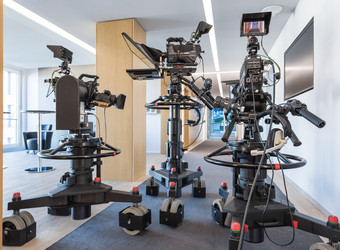
Primarily, it's the live streams. But that also includes preparation, coordinating with the client, and follow-up. We also analyze statistics. Besides that, I also handle other technical tasks. It's a broad field.
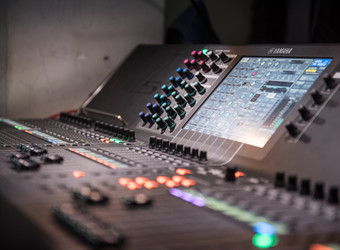
Yes, you're also part of our tech team and sometimes help me out in the audio studio, for example. Maxi, can you describe what a typical day looks like for you? Or is every day really different?
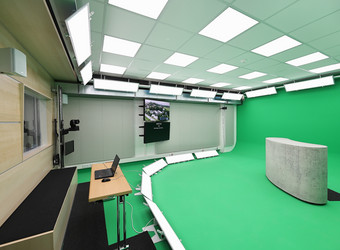
Well, there isn't really a typical day, because it all depends heavily on the project. Let's take a day when a webinar is taking place in the green screen studio: I'm in the studio about an hour and a half before the webinar starts, preparing everything. Then the webinar runs, and afterward, I edit the recordings, process them, and upload them. If there aren't any events scheduled, I use the time to, for example, maintain the equipment or prepare for other events.
Of course, the equipment always has to work when it's needed. Above all, I keep in mind: the picture and sound have to be perfect! But I think it's not quite that simple to make sure the streaming actually works properly, is it?
It's actually not that simple. Of course, picture and sound are the two most important components. Although a shaky picture is more easily forgiven than bad sound. But there are many other small details to consider, such as the cabling and ensuring all connectors are properly seated. It's important to prepare everything thoroughly and rehearse beforehand.
Streaming really took off during the COVID-19 pandemic. Suddenly, everything was being streamed. But you can see that this is slowing down a bit now. Do you think the frequency of streamed events will decrease even further? Or do you think it will stay at its current level?
You can't say for sure. Of course, the trend is toward less frequent streaming. But there are also many hybrid events now, where people try to combine both. And I think that, especially nowadays, this combined approach is essential. Only in this way can you sustainably increase your reach.
You mentioned earlier that every single cable has to be connected correctly for everything to work. Have you ever had a major mishap?
Of course, mishaps happen from time to time, sometimes minor, sometimes major. The classic problem is that the microphone isn't on, and sometimes there are internet outages. Those are the two biggest sources of problems. I once had a real mishap with my hobby, sports streaming. I wanted to broadcast a handball game live. But because the arena was so well insulated that there was no internet connection, I had even run a separate connection to the satellite dish outside, and then a car in the parking lot drove into that satellite dish.
The broadcast was then canceled, I assume?
In that case, the broadcast was canceled, yes.
Looking back on your time at mbw, is there a highlight event?
Wow, I couldn't really name just one highlight event. Every event is interesting in its own way and always presents new challenges.
That sounds like a great job. Have you found your dream job?
You could say that. Streaming was my hobby, and I really enjoyed it. So, yes!
But if you've turned your hobby into your profession, then you don't have a hobby anymore. Or have you found a new one?
The hobby has basically stayed the same!
Hobby and profession combined – that sounds like the perfect solution. And I always find it fascinating to see the different career paths and professions people have. Thank you so much for sharing your journey with me.
You're very welcome.